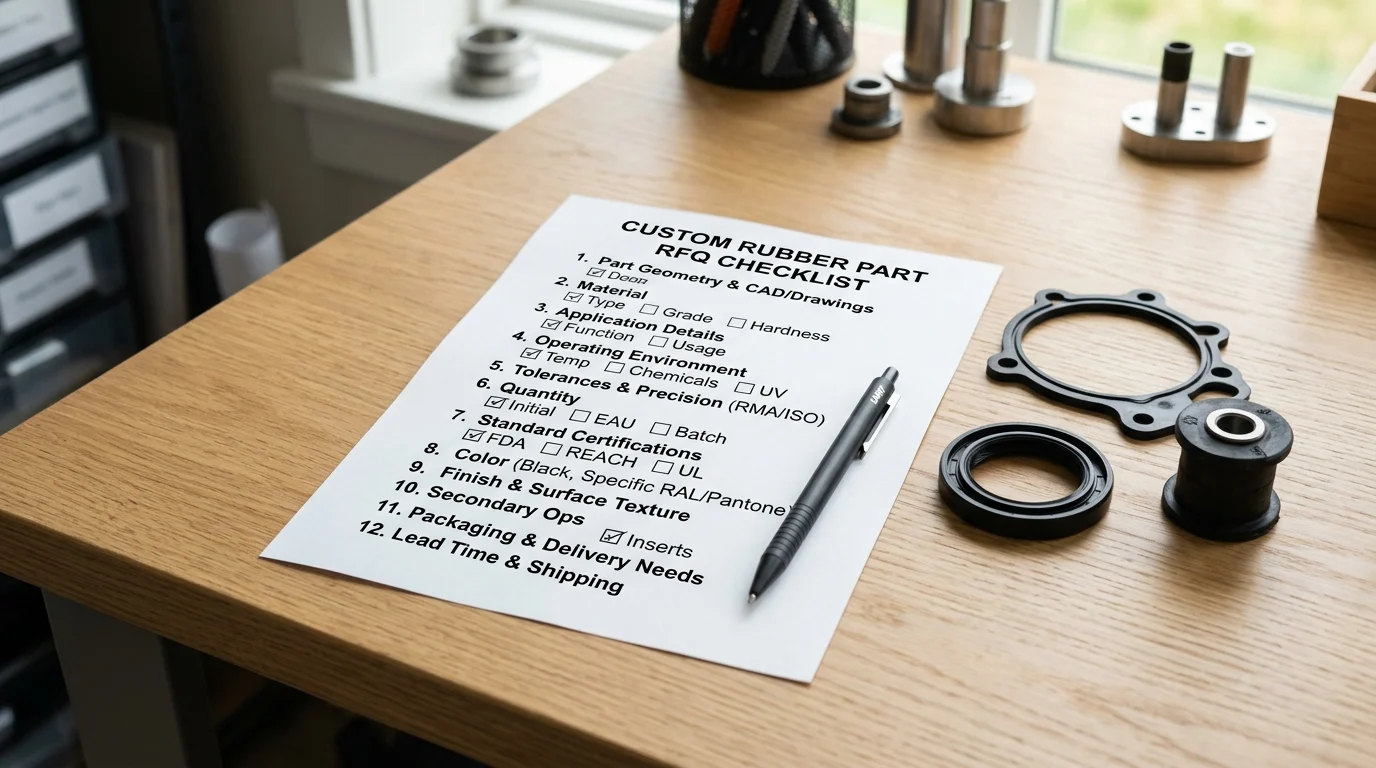
A rubber part quote is only as accurate as the information behind it. Missing drawings, unclear tolerances, vague material requirements, or uncertain production volumes can turn a straightforward sourcing project into weeks of emails, revised pricing, and preventable tooling changes. For procurement, engineering, and product teams, a structured RFQ is more than paperwork—it is a control point for cost, lead time, and manufacturability. This guide explains the critical details suppliers need to evaluate custom rubber components, from CAD files and part function to annual usage and tooling expectations, so you can receive faster quotes, reduce rework, and move from concept to production with fewer surprises.
Why a Custom Rubber Part RFQ Checklist Matters
In custom manufacturing projects, procurement teams consistently struggle with delayed timelines and inaccurate pricing simply because of poorly defined Requests for Quote (RFQs). When sourcing custom rubber components, the initial RFQ serves as the foundation for the entire manufacturing relationship. A comprehensive checklist is not just an administrative formality; it is a critical engineering and financial tool.
Without a structured checklist, project kickoff times are often delayed by 30% to 40%. Suppliers are forced to make assumptions about tooling complexity, material shrinkage, and production cycles, inevitably leading to a cycle of back-and-forth emails and revised quotes. By utilizing a standardized checklist, ambiguity is eliminated, allowing manufacturers to provide precise cost breakdowns and realistic lead times from day one.
What to Clarify Before Requesting a Quote
Before drafting an RFQ to send to potential manufacturing partners, strict internal alignment is necessary. Define the exact scope of the project, including the core problem the rubber part is solving and the financial boundaries of the procurement cycle.
For instance, clarify whether the project requires a short-run prototyping batch of 500 units or mass production with an Estimated Annual Usage (EAU) of 50,000 units. This volume distinction drastically alters the type of tooling a supplier will quote—ranging from single-cavity aluminum prototype molds to multi-cavity, hardened steel production molds. Clarifying these parameters internally prevents requesting quotes for manufacturing processes that do not align with the actual budget or timeline.
Complete RFQ vs. Incomplete RFQ
The difference between a complete and an incomplete RFQ is often measured in lost capital and extended lead times. An incomplete RFQ relies heavily on supplier assumptions, meaning the initial price is rarely the final price paid. Conversely, a complete RFQ locks in variables, ensuring that the quotes received are accurate, actionable, and ready for a purchase order.
The stark contrast in project outcomes between the two approaches is evident in the table below:
| Metric | Complete RFQ | Incomplete RFQ |
|---|---|---|
| Quote Turnaround Time | 2 to 4 business days | 10+ days (due to RFI delays) |
| Cost Accuracy | Within ±2% of final cost | Up to ±25% variance |
| Tooling Revisions | 0 to 1 iterations | 3 or more iterations |
| Defect Risk | Minimal (specs strictly defined) | High (due to assumed tolerances) |
12 Details to Include in Your RFQ

To ensure suppliers have every piece of data necessary to evaluate tooling feasibility and material selection, rely on a strict 12-point checklist. Providing these details upfront prevents costly misunderstandings. Tooling costs for custom rubber molding can easily range from $1,500 for simple compression molds to over $15,000 for complex liquid silicone rubber (LSR) injection molds, making precision in the RFQ absolutely essential.
Part Function, Drawings, and CAD Files
The first six details on the checklist focus on the physical geometry, functional intent, and commercial volume of the part.
1. 2D Drawings with Tolerances: Always provide a fully dimensioned 2D PDF drawing. Crucially, specify the exact dimensional tolerances required, such as ISO 3302-1 Class M2 for high-precision molded rubber parts.
2. 3D CAD Files: Include native 3D models (typically STEP or IGES formats). This allows the supplier's engineering team to run mold flow analysis and accurately calculate part volume and weight.
3. Part Function: Explicitly define whether the part acts as a static seal, a dynamic dampener, or a protective boot. Knowing the application helps the supplier identify potential design flaws before cutting steel.
4. Estimated Annual Usage (EAU): State the expected yearly volume. This dictates the optimal number of cavities in the mold to balance piece price against upfront tooling costs.
5. Minimum Order Quantity (MOQ): Outline preferred release quantities per shipment, which impacts the supplier's inventory and setup cost calculations.
6. Target Price: Whenever possible, share a realistic target piece price. This immediately filters out suppliers whose overhead or technological capabilities do not align with the budget.
Material, Performance, and Application Requirements
The remaining six details address the chemical, environmental, and logistical demands placed on the custom rubber component.
7. Base Polymer: Specify the exact material family required, whether it is NBR (Nitrile) for oil resistance, EPDM for outdoor weathering, or Silicone for medical applications.
8. Durometer (Hardness): Define the required material hardness using the Shore A scale, typically including a standard tolerance band (e.g., 60±5 Shore A).
9. Operating Temperature Range: Provide the continuous operating temperature and peak exposure limits (e.g., continuous exposure at -40°C to 150°C). This prevents premature thermal degradation of the part in the field.
10. Chemical Exposure: List any fluids, gases, or environmental factors (like UV or ozone) the rubber will contact. A part exposed to automotive brake fluid requires a vastly different compound than one exposed to drinking water.
11. Industry Compliance: Note all necessary regulatory standards, such as FDA Title 21 CFR 177.2600 for food contact, RoHS, or REACH compliance. Testing and certification documentation add to the cost and must be quoted upfront.
12. Packaging and Shipping: Define how the parts should be delivered. If specific bagging, kitting, or barcode labeling is required to feed directly into automated assembly lines, state this to avoid hidden handling fees later.
How to Use the RFQ Checklist
Having a comprehensive checklist is only half the battle; integrating it into the procurement workflow is where true value is realized. By standardizing the RFQ format across all potential manufacturing partners, quote variance can drop from an unpredictable 25% down to under 5%. This consistency guarantees an apples-to-apples comparison when evaluating supplier responses.
Step-by-Step RFQ Process
Approach RFQ distribution systematically by sending the complete checklist and all associated files to a vetted list of suppliers simultaneously. This ensures a fair, efficient, and accurate quoting process that sets the foundation for a successful manufacturing partnership.
Key Takeaways
- Clarify project scope, budget limits, and production intent before sending an RFQ to avoid quoting processes that do not match your real timeline or cost targets.
- Include expected volume or estimated annual usage because a 500-unit prototype run and a 50,000-unit production program require very different tooling strategies.
- Provide drawings, CAD files, tolerances, material requirements, and functional details upfront so suppliers can quote with fewer assumptions and fewer follow-up questions.
- A complete RFQ can reduce quote turnaround to 2 to 4 business days, while incomplete RFQs may take 10 or more days due to clarification delays.
- Precise RFQ details help control tooling costs, which may range from about $1,500 for simple compression molds to more than $15,000 for complex LSR injection molds.
- Use a standardized checklist to reduce rework, limit tooling revisions, and improve cost accuracy to within about ±2% of the final project cost.
Frequently Asked Questions
Why does a detailed RFQ matter for custom rubber parts?
A detailed RFQ reduces supplier assumptions about material, tooling, tolerances, and production volume. This helps manufacturers quote faster, estimate lead times more accurately, and avoid costly revisions after the project starts.
How much faster can a complete RFQ be quoted?
According to the article, a complete RFQ can often be quoted in 2 to 4 business days, while an incomplete RFQ may take 10 or more days due to clarification requests and missing technical details.
What files should I include with a rubber part RFQ?
Include 2D drawings, 3D CAD files, part function notes, critical dimensions, tolerances, and any assembly or mating-part information. These details help suppliers assess tooling feasibility and manufacturing risk.
Why is estimated annual usage important?
Estimated annual usage helps determine the right tooling strategy. A 500-piece prototype run may use simpler tooling, while 50,000 units per year may justify multi-cavity hardened steel production molds.
What cost risks come from an incomplete RFQ?
Incomplete RFQs can create price variance of up to ±25% because suppliers must make assumptions. Missing details may also lead to tooling revisions, longer lead times, and higher defect risk.